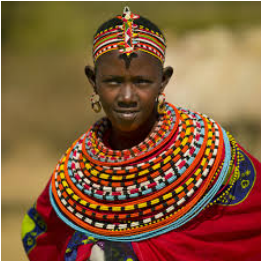
 A young, beaded Samburu woman A young, beaded Samburu woman It's been over a week since the taping of the BBC Global Questions program on Woman and Equality in Africa and I am still here in Nairobi. The anthropologist in me could not resist the compelling urge to conduct some spontaneous ethnography among the varied groups of women who practice or have abandoned the the practice of female circumcision (or what opponents refer to as female genital mutilation): The Samburu (who are related to the Maasai), the Maasai, the Kenyan "Somali", and the Pokot are among the strongest supporters of their tradition while the Kikuyu have largely abandoned the practice in favor of westernization. In the short time I've been here I've managed to meet and speak with a few of these women. "Mary" is in her early fifties and hails from Samburu district. She is a staunch anti-FGM activist and sat down to talk to me about how and why she became an activist. I was fascinated by her story, which I will feature in the special January 2016 edition of SiA Magazine. One of her main points: Female circumcision in her society is inextricably linked with immediate marriage and reproduction. Girls as young as 10 and 11 are circumcised and are expected to marry and begin bearing children immediately afterwards. Interestingly, Mary talked about how girls are encouraged to have boyfriends among their young clansmen and have sex prior to their circumcision and marriage and that it is female elders who perform abortions if the these girls accidentally become pregnant. My first thought was, wow! Although, I am already familiar with much of the ethnography on female initiation and circumcision among Nilotic groups in East Africa, I suddenly thought of how Mary's accounts of girls' sexuality so completely contradicts western stereotypes and the global media meta-narrative of FGM - that African girls and women are sexually repressed and controlled by men.  L. A Kikuyu woman in the 1930s "Sally", on the other hand, is a 33 year old Kikuyu woman who came to Nairobi nearly ten years ago after her divorce to find a job as a domestic worker. She was 18 years old when she was circumcised, however she told me that it is very rare these days to see Kikuyu women under the age of 40 years who have gone through the practice. According to Sally, none of her younger sisters are circumcised and she asserted that she has no intention of circumcising her own daughters. When I asked why that is, Sally replied that the younger generation have abandoned their culture and traditions in favor of westernization and that she did not want to be the only one following tradition. I asked Sally whether she had any bad experiences in relation to her circumcision and whether she felt that the surgery had inhibited her ability to enjoy sex. Sally laughed. She stated that because westerners have educated Africans about the harmfulness of female circumcision, many Kikuyu feel they must leave the practice. However, Sally insisted that she could not see any difference between herself, her sisters and her adult daughters as far as health and childbirth issues are concerned. On sexual matters, Sally said confidently that she enjoyed sex with her husband (she is now divorced) and did not have any problems as far as she is concerned. I will also feature the rest of Sally's story in the next edition of SiA Magazine. What I learned in these few days from these women's stories and others I've spoken to here in Nairobi is that as African women we can have sobering conversations about female circumcision and even use whatever language we choose to describe the practice and still respect one another as sisters making choices that suit our lived realities. But can African girls and women really make a choice about female circumcision? Unfortunately, I didn't really get to answer that question during the BBC Global Questions show. That will be topic of next Tuesday's blog and a key theme of an upcoming lecture in Washington DC this December. Don't forget, the BBC Global Questions programme airs this weekend Saturday November 14th and Sunday November 15th. Transmission World News TV: Weekend of 14th November World Service Radio: Weekend of 14th November GMT TX times on World TV: Sat 14th November 01:10, 15:10 Sun 15th November 09:10, 20:10 World Service Radio Sat 14th first TX: 20.00 GMT Sun 15th last TX 12.00 GMT  Fuambai Sia Ahmadu, Phd Editor in Chief, SiA Magazine
Co-Founder, African Women are Free to Choose www.fuambaisiaahmadu.com fuambai.ahmadu@gmail.com |
Archives
March 2024
Categories
All
|
 RSS Feed
